
"Where Time Rests"
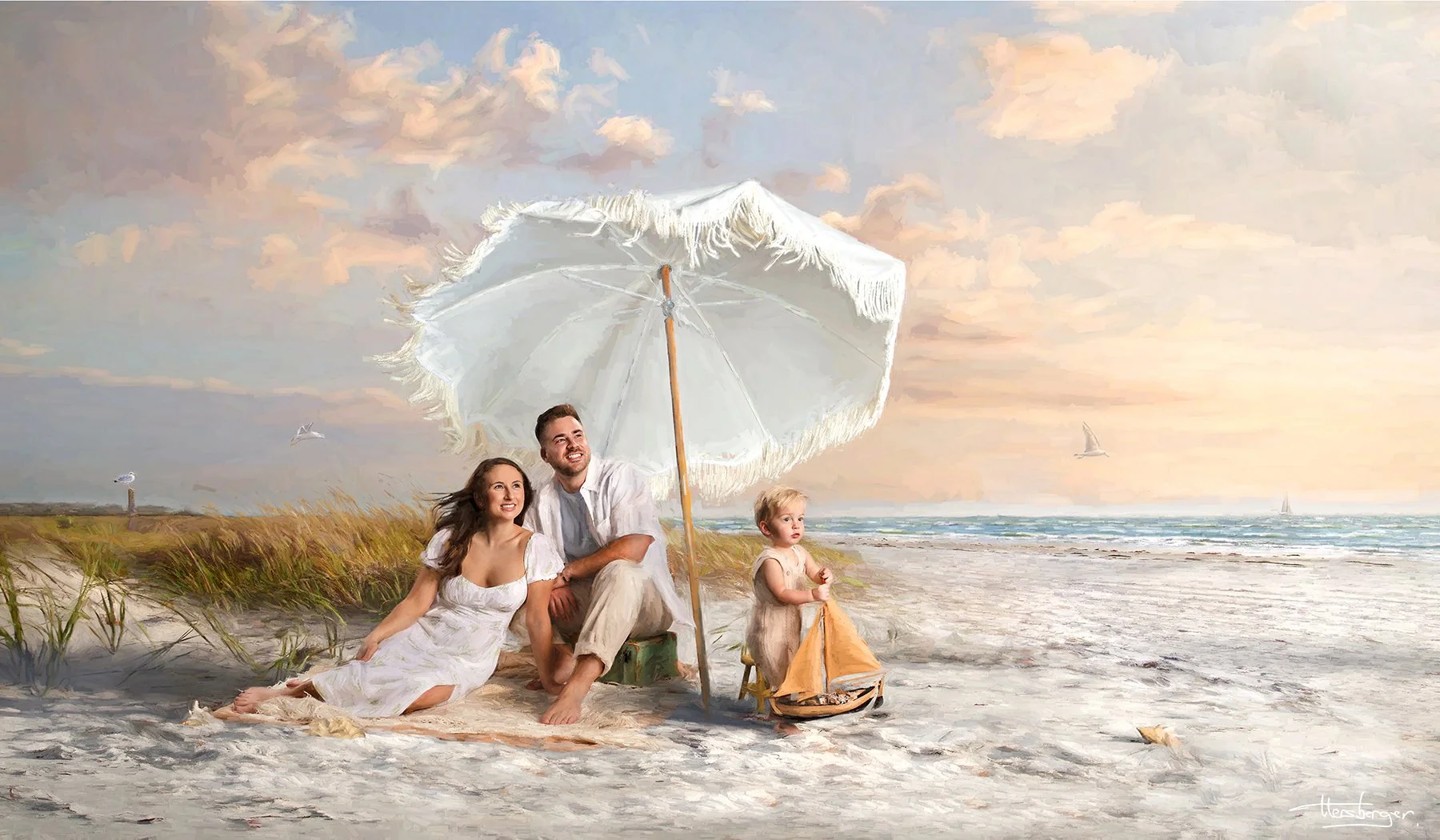
Provenance:
Title: "Where Time Rests"
Artists: Ela and Larry Hersberger
Date of Creation: February 2026
Location of Creation: Florida, United States
Subject: Commissioned portrait by the Colucci Family.
ABOUT THIS ARTWORK
A study in light, texture, and timeless connection.
This piece captures a serene coastal moment through soft tonal harmony, where composition, atmosphere, and emotion exist in quiet balance.
Designed to evoke both elegance and intimacy, it reflects the essence of modern heirloom art.
A gentle presence in any space, it brings warmth, softness, and a sense of calm into the home.
WHY THIS IS A MASTERPIECE
This piece may feel soft and modern at first glance, but beneath its calm surface lies a structure deeply rooted in the traditions of the Old Masters. What gives it that timeless quality is not just the subject—but the geometry quietly guiding every element.
At the core of the composition is a classical triangular structure. The mother, father, and child form a stable triangle—a technique used by Renaissance masters like Leonardo da Vinci and Raphael to create harmony and unity. This triangular arrangement anchors the viewer’s eye and brings a sense of calm balance to the scene.
Framing this triangle is a powerful central element: the white umbrella. Acting as both a visual and symbolic anchor, it forms a soft circular shape—almost like a halo—drawing attention inward. This use of a dominant central form echoes Baroque compositions, where structure organizes emotion.
A subtle vertical axis, created by the umbrella pole, reinforces stability, while the low horizon line introduces openness and calm. Positioned near the lower third, the horizon allows the sky to breathe, giving the piece emotional depth and space.
the Golden Ratio
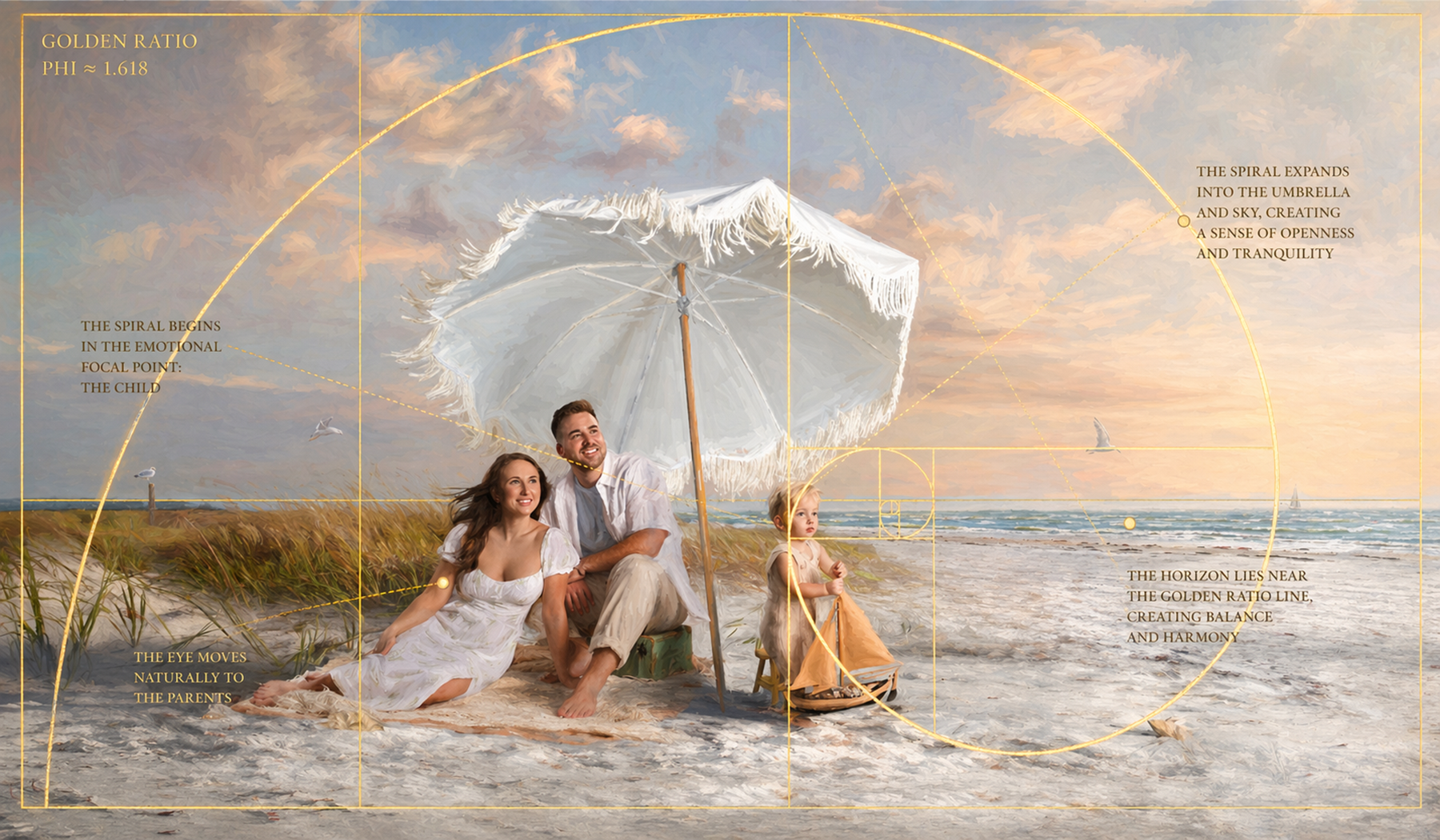
The placement of the child slightly to the right introduces a quiet tension. While the parents remain grounded, the child explores—creating movement within stillness. This balance between structure and freedom reflects principles similar to the Golden Ratio, guiding the viewer’s eye naturally through the composition.
There are also invisible leading lines at work. The shoreline gently directs attention toward the child, while the parents’ gaze extends the narrative outward. These subtle cues mirror techniques used by Old Masters to guide storytelling without obvious direction.
Light, too, is carefully constructed. The brightest focus rests on the umbrella and faces, gradually softening into the background. This creates a pyramidal light structure, reminiscent of painters like Caravaggio and Rembrandt, where illumination becomes a compositional tool.
Depth is achieved through classical layering: foreground, middle ground, and background. The textured sand, the grounded figures, and the softened horizon work together to create a sense of space while maintaining a dreamlike quality.
What makes this piece especially compelling is its asymmetrical balance. While the umbrella centers the composition, the child offsets the weight, introducing a natural, lived-in feel—something often seen in Baroque works where perfection gives way to realism.
Ultimately, this work succeeds because it blends modern sensitivity with classical discipline.
Triangle for stability.
Circle for unity.
Vertical axis for structure.
Horizon for calm.
Light for focus.
These are the same principles that allowed Old Master paintings to endure, and they are what give this piece its quiet, lasting power.