
Bucketful of Summer
Provenance:
Title: “Bucketful of Summer”
Artists: Ela and Larry Hersberger
Date of Creation: March 2026
Location of Creation: North Carolina, United States
Subject: Commissioned portrait by the Hamilton Family.
ABOUT THIS ARTWORK
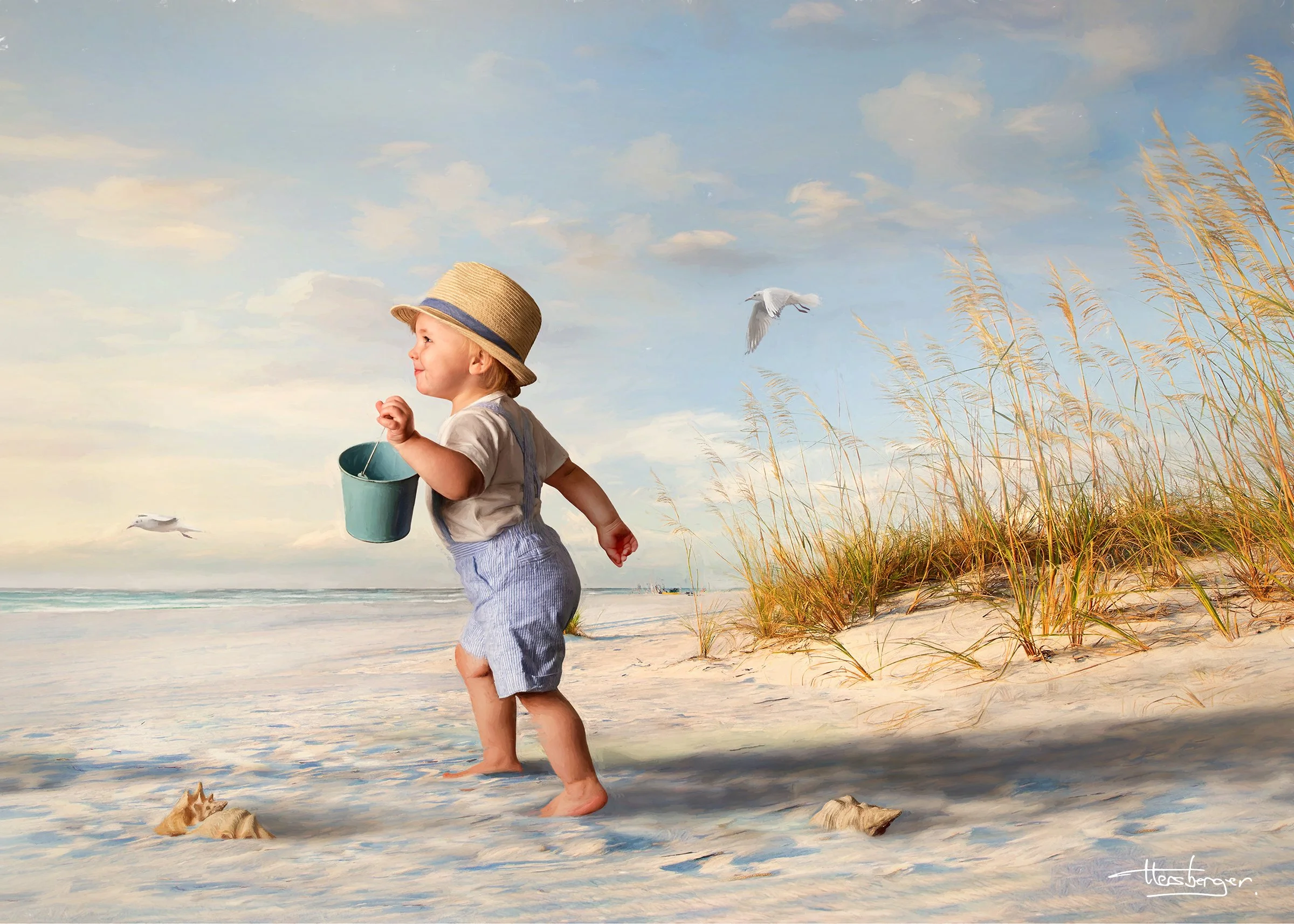
Bucketful of Summer captures the fleeting poetry of early childhood through the language of light, atmosphere, and movement. A young child runs barefoot along the shoreline carrying a small blue bucket, suspended between innocence and discovery. The painting is not merely about the beach; it is about memory itself: the warmth of salt air, the softness of sand underfoot, and the fragile wonder that exists before the world becomes complicated.
The expansive sky and luminous coastal palette create a sense of openness and emotional freedom, while the delicate seabirds and dune grasses reinforce the rhythm of nature surrounding the child. Every element contributes to a feeling of quiet transcendence, an ordinary moment elevated into something timeless.
Rather than relying on sentimentality, the work seeks emotional truth through restraint, atmosphere, and tenderness. It invites the viewer not simply to observe childhood, but to remember it.
THE MAKING OF A MASTERPIECE
This artwork was created to capture the beautiful busyness of being two years old, that age when every shell matters, every bird is exciting, and every trip to the beach feels like a full adventure. At two, children move through the world with complete curiosity. They are always exploring, collecting, wandering, noticing. There is innocence in it, but also purpose.
The wide sky, soft shoreline, and open air were designed to surround little Myles with that feeling of endless discovery. He is placed slightly off-center so the painting feels natural and alive, as though he has simply wandered into this moment on his own, focused on whatever tiny treasure might fill his blue bucket next.
The dunes and sea grass gently guide the eye through the composition while balancing the movement of his small figure against the openness of the coast. The colors were intentionally kept soft and harmonious so the atmosphere could carry the emotion quietly, without overwhelming the tenderness of the scene.
The brushwork becomes more detailed around Myles and softer farther away, allowing the artwork to feel less like a posed portrait and more like a memory — fleeting, warm, and real.
At its heart, this art is about something many people recognize instantly once they see it: the bittersweet beauty of watching a two-year-old being completely busy with life, unaware that these small moments will someday become precious memories for everyone else.
WHY THIS IS A MASTERPIECE
Bucketful of Summer transcends illustration by achieving unity between structure, atmosphere, and emotional resonance. The artwork succeeds because every visual decision serves the same poetic experience.
Its strength lies not in spectacle, but in inevitability.
Nothing feels excessive. Nothing feels decorative. The openness of the sky, the softness of the dunes, the placement of the birds, the smallness of the figure against the vast coastal environment—all contribute to a singular emotional truth: the fleeting purity of childhood wonder.
The artwork deepens over time because it operates simultaneously on multiple levels:
as a beautifully observed coastal scene,
as a meditation on memory,
and as a symbolic reflection on innocence and transience.
The work also demonstrates advanced formal authority through atmospheric control, spatial coherence, chromatic restraint, and compositional rhythm. Yet technical mastery never overwhelms the emotional core of the piece.
Ultimately, the artwork lingers because viewers recognize something deeply human within it—not merely a child at the shore, but the fragile experience of time passing quietly through our lives.
GEOMETRIC STRUCTURE
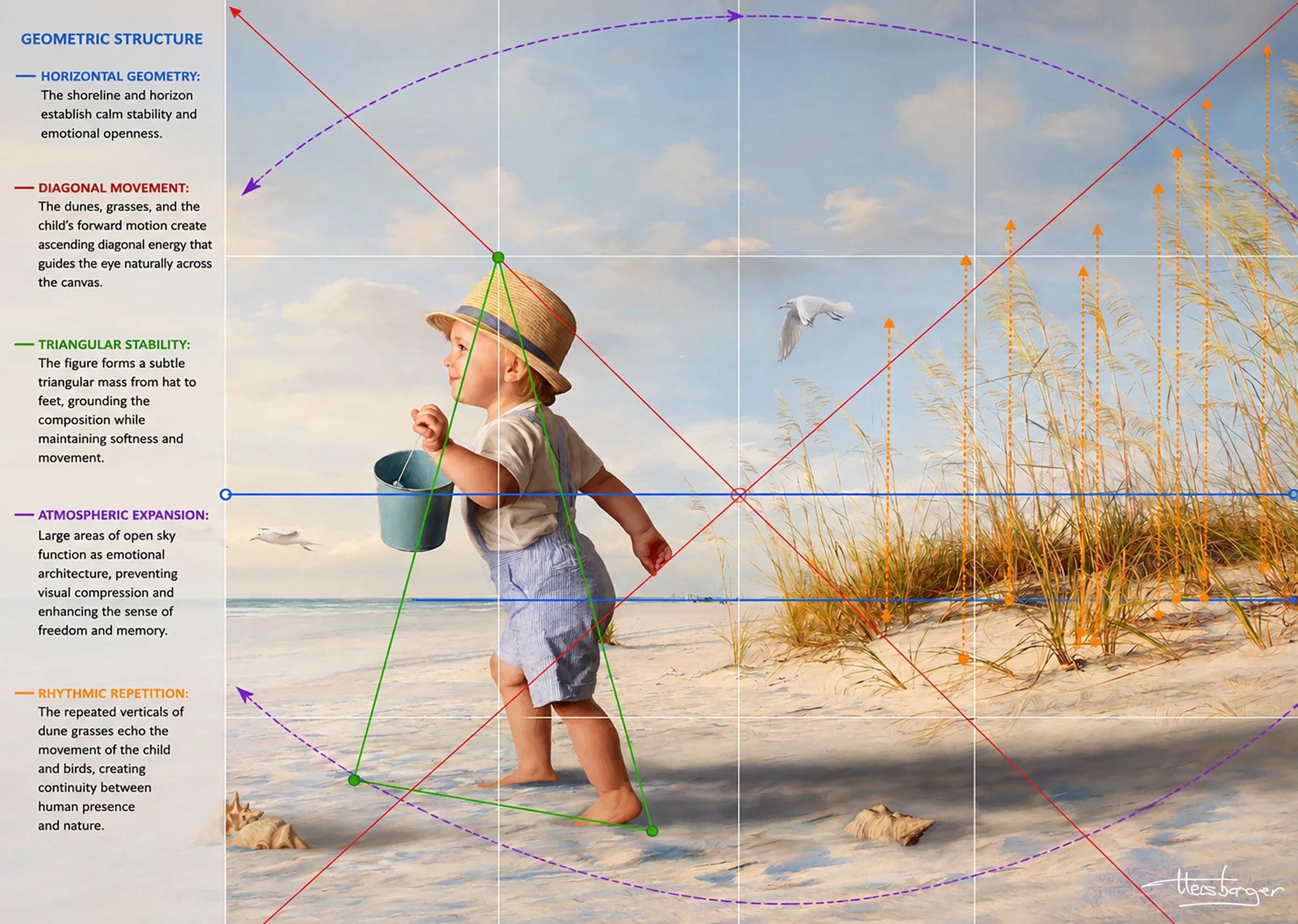
The geometric foundation of Bucketful of Summer is built upon asymmetrical balance and directional flow.
The child occupies a primary focal intersection near the lower-left third of the composition, creating immediate engagement while allowing the surrounding atmosphere to breathe. This placement generates forward momentum toward the open horizon.
Several structural systems work simultaneously:
Horizontal Geometry:
The shoreline and horizon establish calm stability and emotional openness.Diagonal Movement:
The dunes, grasses, and the child’s forward motion create ascending diagonal energy that guides the eye naturally across the canvas.Triangular Stability:
The figure forms a subtle triangular mass from hat to feet, grounding the composition while maintaining softness and movement.Atmospheric Expansion:
Large areas of open sky function as emotional architecture, preventing visual compression and enhancing the sense of freedom and memory.Rhythmic Repetition:
The repeated verticals of dune grasses echo the movement of the child and birds, creating continuity between human presence and nature.
The geometry is intentionally concealed beneath naturalism. Rather than appearing rigid or designed, the structure supports the illusion of effortless spontaneity—one of the defining characteristics of museum-caliber composition.